
Checking Criminal History in Council Bluffs
Begin with the kind of Council Bluffs record needed. A police narrative belongs to the Council Bluffs Police Department. A present-custody entry belongs to the Pottawattamie County Jail. A filed charge, hearing, judgment, or dismissal belongs to the Clerk of District Court. Iowa DCI supplies a distinct statewide, fingerprint-supported history. One name search cannot replace all four.
Use a case or incident number whenever it is known. Exact dates, locations, and an involved party also help city staff locate a Council Bluffs police record without turning the request into a broad search.
- Ask Council Bluffs Police Records Management for an initial incident or accident report, or use the city portal for added material.
- Identify the event with its case number, date, location, involved party, and the exact record category requested.
- Check the county inmate roster or call Jail Booking if the event involved custody at Big Lake Road.
- Search Iowa Courts Online with the Pottawattamie County filter to read filed charges and dispositions.
- Use Iowa DCI when a statewide Iowa history, rather than one Council Bluffs event, is needed.
Council Bluffs GovQuest Record Requests
The city routes requests for added reports, photographs, video, Animal Control records, and other investigative material through the official Council Bluffs GovQuest portal. The form asks for requester contact details, record type, incident or case number, event date and location, involved party, a detailed description, delivery choice, and any conditional attachment or court order. A free submission is not a promise of free copies. City staff may quote search, review, or copy costs after examining the request.
The official GovQuest portal view shows why a narrow Council Bluffs criminal records request works best.
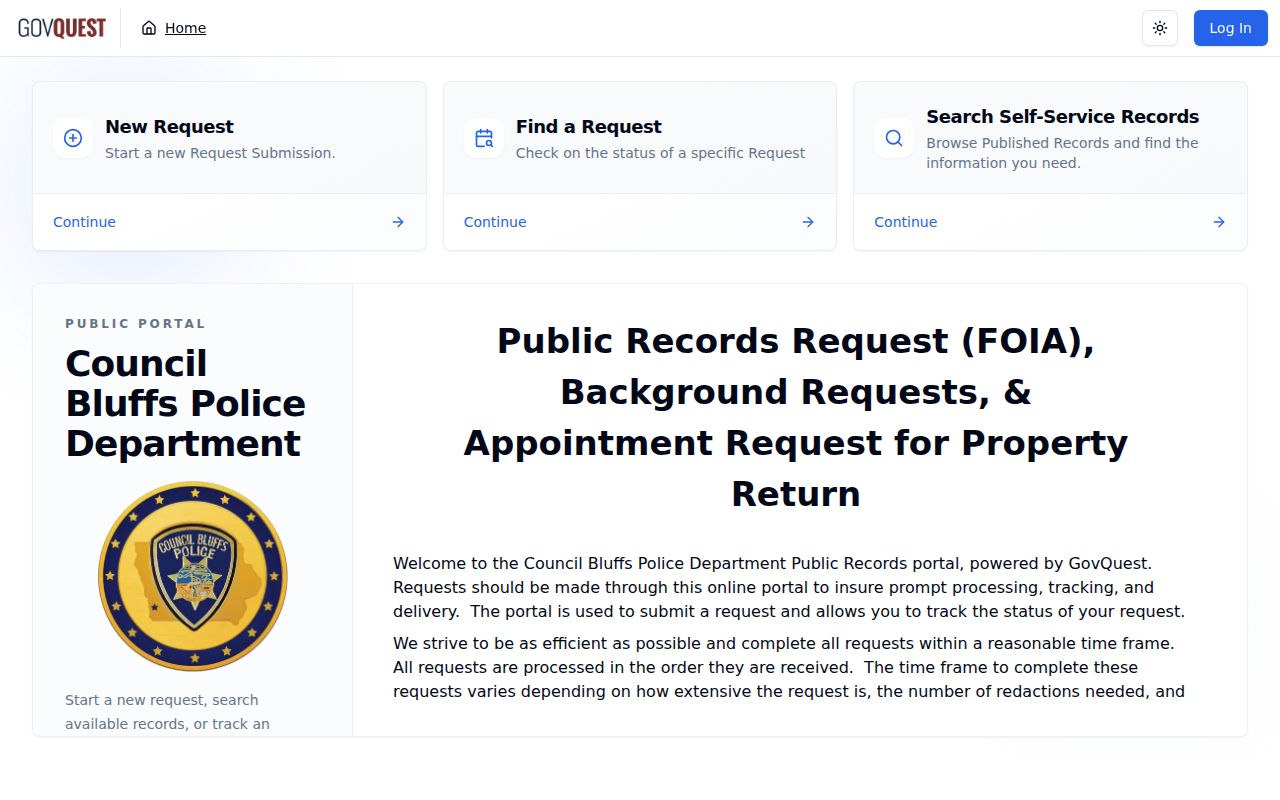
Its fields give staff the facts needed to locate a city file and decide whether Legal review, redaction, or a fee estimate is required.
| Best Locator | Incident or case number, if known |
|---|---|
| Event Details | Date, time, location, and involved party |
| Record Choice | Report, video, Animal Control, traffic footage, or other material |
| Request Detail | The desired portion, format, and delivery method |
| Possible Follow-Up | Legal review, redaction, fee estimate, or a court-order attachment |
Council Bluffs Police Department Records
CBPD Records Management operates at 1 Ezra Jackson Way. The public lobby is open from 7:00 a.m. to 6:00 p.m. on weekdays and closes on holidays. The main number is 712-890-5400. Telephone reports use 712-328-4716, while records manager Chad Nation can be reached at 712-328-4715. An initial incident or accident report may be obtained at the entrance when the requester brings the case number.
The city’s official Records Management view identifies the Council Bluffs unit that handles these police files.
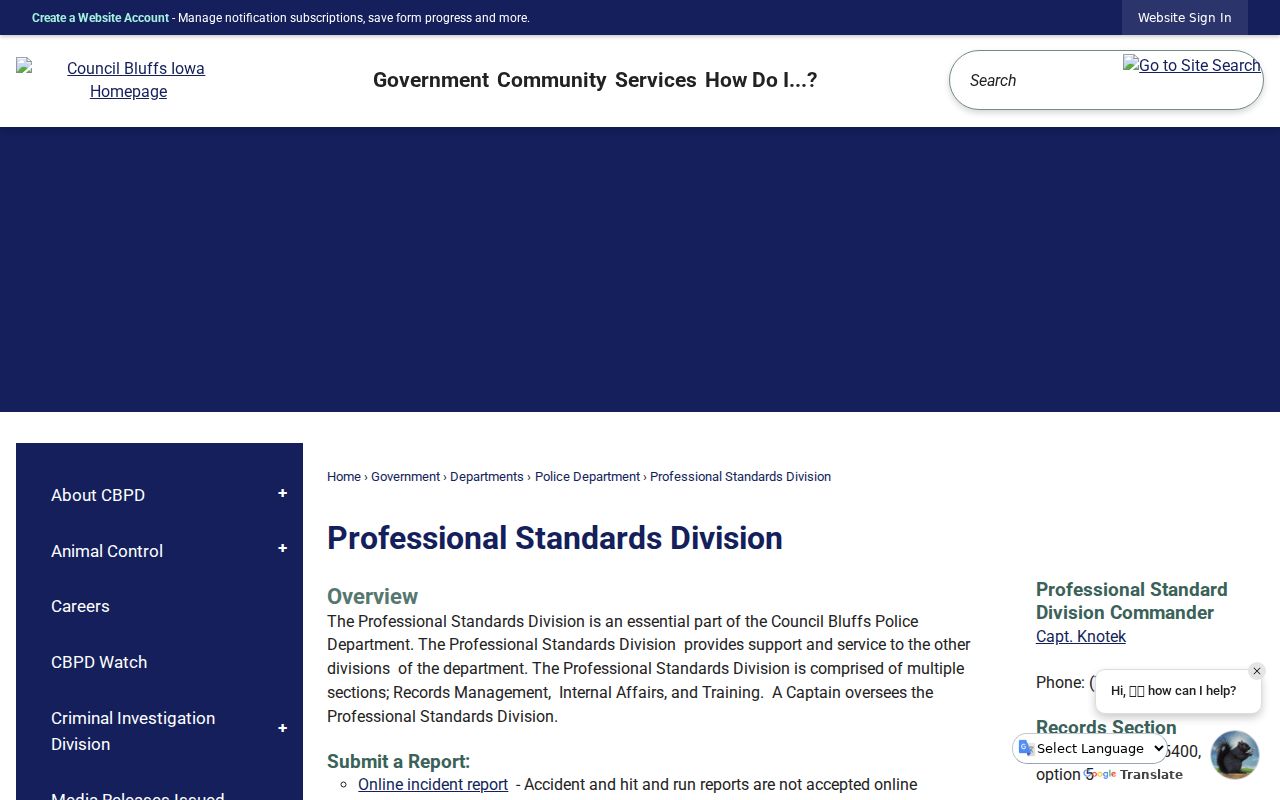
That local counter is the right first stop for a CBPD narrative. The county clerk does not keep the police investigation, and the sheriff should not be asked for a report created by Council Bluffs officers.
CBPD Records Management
1 Ezra Jackson Way
Council Bluffs, IA
712-890-5400
Public lobby: 7:00 a.m. to 6:00 p.m. weekdays, closed holidays.
Two Council Bluffs Report Routes
An initial report and an investigative file use different Council Bluffs channels. The station entrance can supply an initial incident or accident report when the case number is available. Extra reports, photos, or video require an investigative-file request and City Legal approval. Active investigations are unavailable until closed. This split often explains why a requester receives a basic record but not every attachment.
| Route | Use It For | What to Expect |
|---|---|---|
| Records lobby | Initial incident or accident report | Bring the case number for the fastest match |
| GovQuest or City Legal | Added reports, photos, video, and investigative material | Review, redaction, and possible fees |
| Iowa Courts Online | Filed criminal charge and case outcome | A court record, not the police narrative |
Submitting to the wrong office can add delay without broadening access. City Legal can review a police file, but it does not replace the Clerk of District Court for a judgment or certified court copy.
Note: Council Bluffs police fees should be confirmed through the portal; the sheriff’s separate fee schedule does not control city requests.
Council Bluffs Arrests and Bookings
Council Bluffs does not have a separate long-term jail documented in the official sources. CBPD transports people for booking at the Pottawattamie County Jail, 1400 Big Lake Road. The jail expressly lists Council Bluffs Police among its booking agencies. Its free current roster can help locate a person in custody, and the booking line is 712-890-2260.
A roster hit shows an intake record, not guilt. It may include booking time, arresting agency, intake charge, bond, and custody status. The list is informational and not an official record. After release, a name may vanish from the current roster even though the Council Bluffs report and Iowa court case remain. For official booking material, contact county Records. For a filed charge and result, use the court docket or the dedicated Pottawattamie County criminal court cases resource.
Council Bluffs Cross-River Record Trails
Council Bluffs sits across the Missouri River from Omaha, with I-29, I-80, and river crossings bringing several agencies and two states into a small area. Geography does not decide who owns a record. The arresting agency and filing court do. A Council Bluffs police stop that leads to a local booking follows Iowa channels, while an Omaha police event follows Nebraska channels even if the person later crosses the river.
Before searching Council Bluffs criminal records, write down the arresting agency, state, incident location, and any case number. Then keep each search within that jurisdiction. The city’s active-warrant PDF is only a lead and not final confirmation because arrests and warrant status can change daily. Confirm a possible warrant with the issuing court or police agency before relying on a list.
Municipal Court Records in Council Bluffs
Council Bluffs has no separate public municipal-court portal documented in the research. City Legal handles municipal ordinance prosecutions, but those matters enter Iowa’s unified district-court structure. Magistrates work within the Iowa District Court. Search Iowa Courts Online with the Pottawattamie County filter, or ask the fourth-floor Clerk of District Court for public terminal access and copies.
| Court Name | Iowa District Court for Pottawattamie County |
|---|---|
| City Case Role | Council Bluffs Legal prosecutes municipal ordinance matters within Iowa’s unified court structure |
| Case Lookup Channel | Iowa Courts Online or the courthouse public-access terminal |
| What the Docket Shows | Case ID, filed charge, events, hearings, disposition, sentence, and public financial entries |
| Copies and Fees | Ask the Clerk at 712-328-5604 for the current copy, certification, or search cost |
The distinction matters. A CBPD report states what police documented. The district-court docket shows what prosecutors filed and how the court resolved each count.
Council Bluffs Telephone Report Limits
CBPD permits telephone or online reporting for listed lower-risk events. Examples include lost property, theft under $1,500, catalytic-converter or cellphone theft, vandalism under $1,500, a vehicle burglary with no evidence, unknown-suspect harassment or identity theft, and attempted fraud with no loss. Call the published telephone-report line to confirm that the current facts fit.
An officer is required when the event involves a known suspect, drugs, firearms or weapons, most serial-numbered property, or a value above $1,500. This is a reporting rule, not a public-record release rule. Once the city creates a report, access still depends on the record’s status, protected content, and whether an investigation remains active.
Where Council Bluffs Records Go
A Council Bluffs police report starts with CBPD. If officers make an arrest, the Pottawattamie County Jail creates the booking entry and takes fingerprints. Prosecutors decide what charge to file, and the Clerk of District Court maintains the case in EDMS and Iowa Courts Online. Court dispositions are then reported to the Iowa Department of Public Safety, Division of Criminal Investigation, Records and Identification Unit.
Record flow: Council Bluffs PD › Pottawattamie County Courts › Iowa Department of Public Safety, Division of Criminal Investigation
Recent Council Bluffs activity may appear first in a police or jail record. The filed case can follow later. DCI is the statewide repository layer, but its public release rules differ from open court access. A signed release affects whether certain completed deferred judgments and older unresolved arrests appear in a DCI result.
Council Bluffs City Legal Review
Council Bluffs City Legal is at 209 Pearl Street, Suite 304. Its office number is 712-890-5317, fax is 712-322-9255, and weekday hours are 8:00 a.m. to 5:00 p.m. Requests may use the city portal, mail, drop-off, fax, or the published city email with a confirmation call. City Legal review is especially relevant to added reports, video, and other investigative material.
The official City Legal page shows the Council Bluffs fallback channel for police-record review.
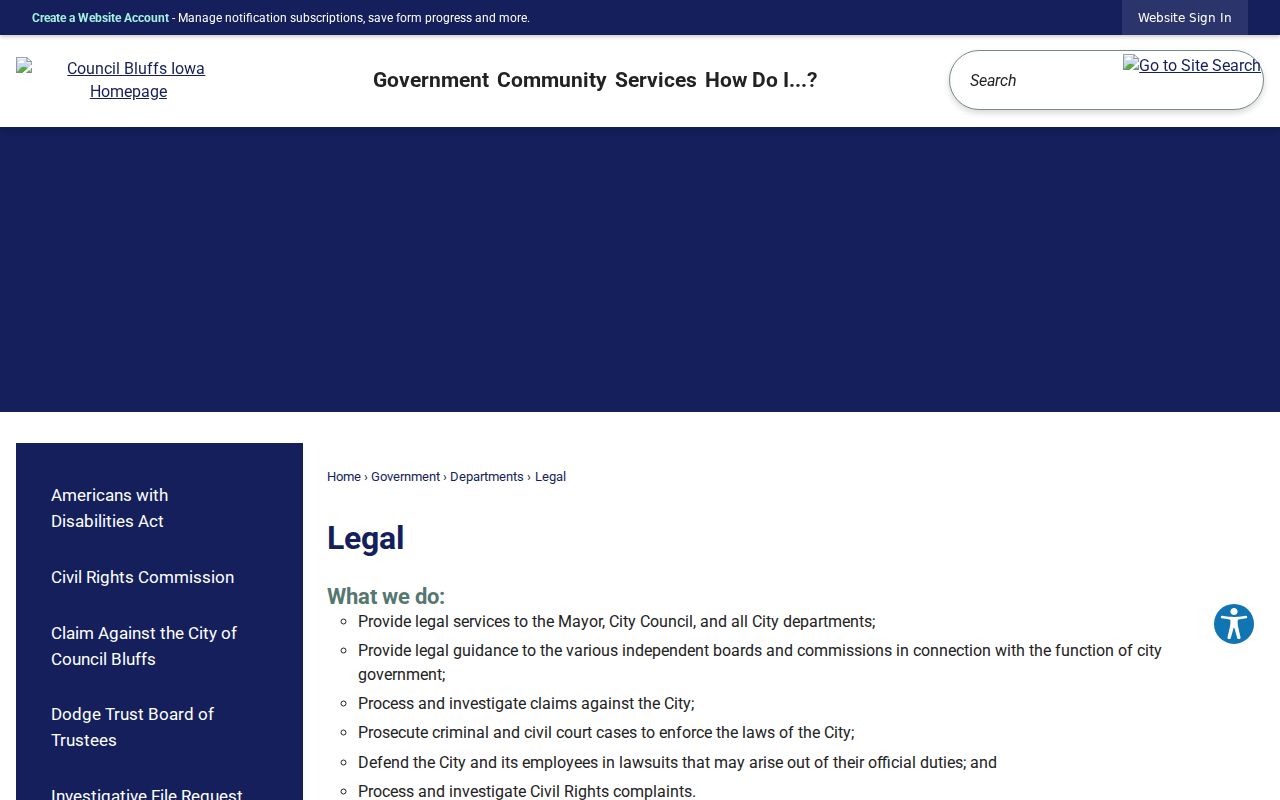
Legal review does not guarantee full release. Staff may withhold protected investigative content and redact confidential identifiers while separating public material when the law permits.
Note: Ask for an estimate before authorizing extensive search, examination, copying, or video review.
Public Access Rules in Council Bluffs
Iowa’s public-record law applies to Council Bluffs records, but it does not open every part of a police file. Date, time, specific location, and immediate facts and circumstances are generally public unless release would seriously harm an investigation or create a clear and present safety danger. Peace-officer investigative reports, criminal intelligence, protected victim or child information, personal identifiers, and medical or mental-health facts can remain confidential.
Key Statutes:
Iowa Open Records Law, chapter 22 gives the public examination and copy rights, permits reasonable fees, and identifies confidential records.
Iowa Code chapter 692 governs criminal-history and intelligence data collected and released through Iowa DCI.
Iowa Code section 232.147 generally keeps juvenile court records confidential unless a law authorizes access.
Ask for the immediate-facts portion and any segregable public material when the full Council Bluffs file cannot be released. A denial of an active investigative file does not mean that no initial report, jail entry, or public court event exists.
When Council Bluffs Records Stay Closed
If CBPD says an investigation remains active, narrow the request before assuming that every Council Bluffs criminal record is closed. Ask whether the initial incident report or the public immediate facts can be supplied now. Give staff the case number and specify the portion sought. Do not ask City Legal to predict when investigators will close a case.
Next, check the county jail record if an arrest occurred and Iowa Courts Online if prosecutors filed a case. Those are separate custodians with separate records. A court docket may be public while the police narrative remains restricted. Later, return to GovQuest for added reports, photographs, or video after the investigation closes. This sequence respects the city’s review process while still checking each official record layer.
The official Council Bluffs Police Department page provides the city’s public contacts and service routes.
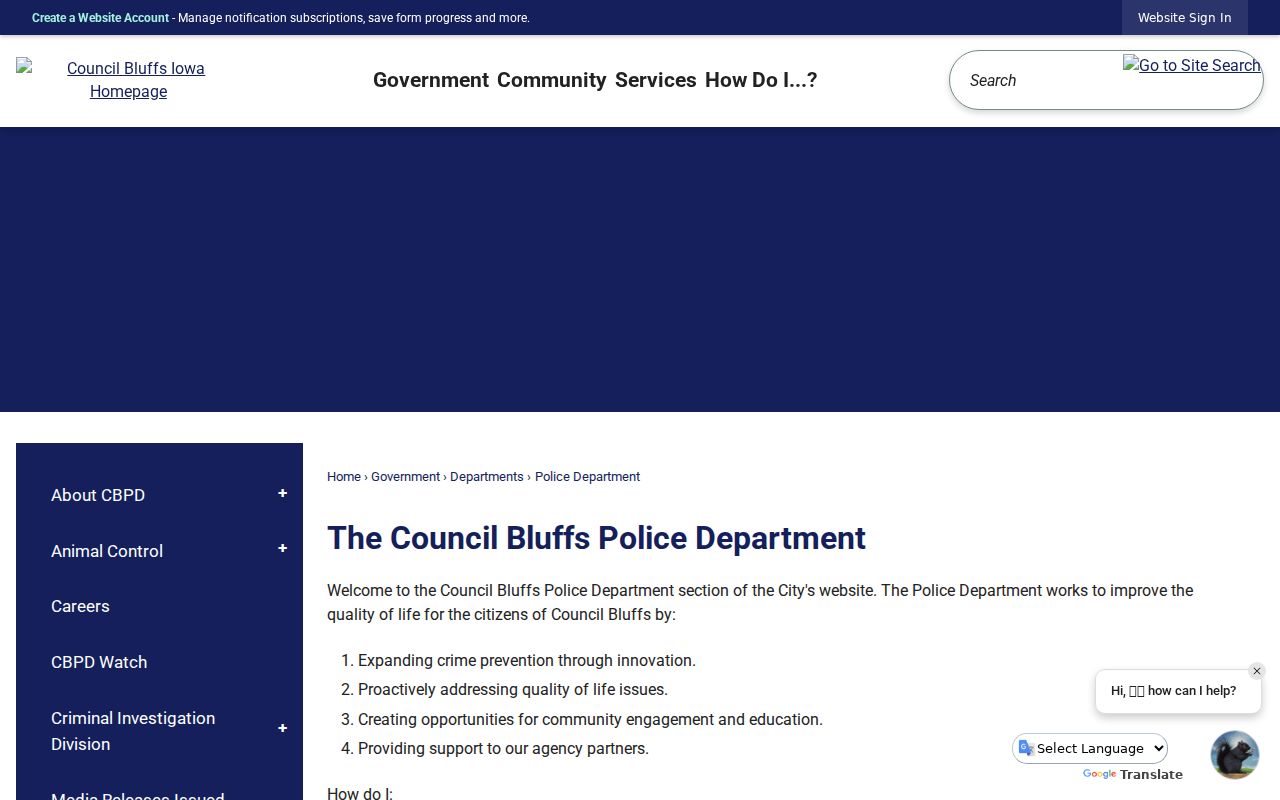
Use those city channels for the police file, then move to county or state offices only for the records they actually maintain.