
Pottawattamie County Criminal Court Cases
The Iowa District Court in Pottawattamie County has general criminal jurisdiction. It handles felonies, aggravated and serious misdemeanors, simple misdemeanors, criminal traffic matters, and later proceedings tied to those cases. Magistrates work within this unified district court. Iowa does not divide local criminal files among separate county, justice-of-the-peace, and municipal court databases. Even Council Bluffs city prosecutions enter the Iowa court structure.
The Clerk of District Court keeps the docket and public case documents. The clerk is on the fourth floor of the courthouse at 227 South 6th Street in Council Bluffs and can be reached at 712-328-5604. District Court Administration uses the same courthouse, with administration at 712-328-5754 and case scheduling at 712-328-5871. The court file, not the jail roster, is the place to confirm a filed charge and final result.
The county court page shows the building and clerk access point used for Pottawattamie criminal cases.
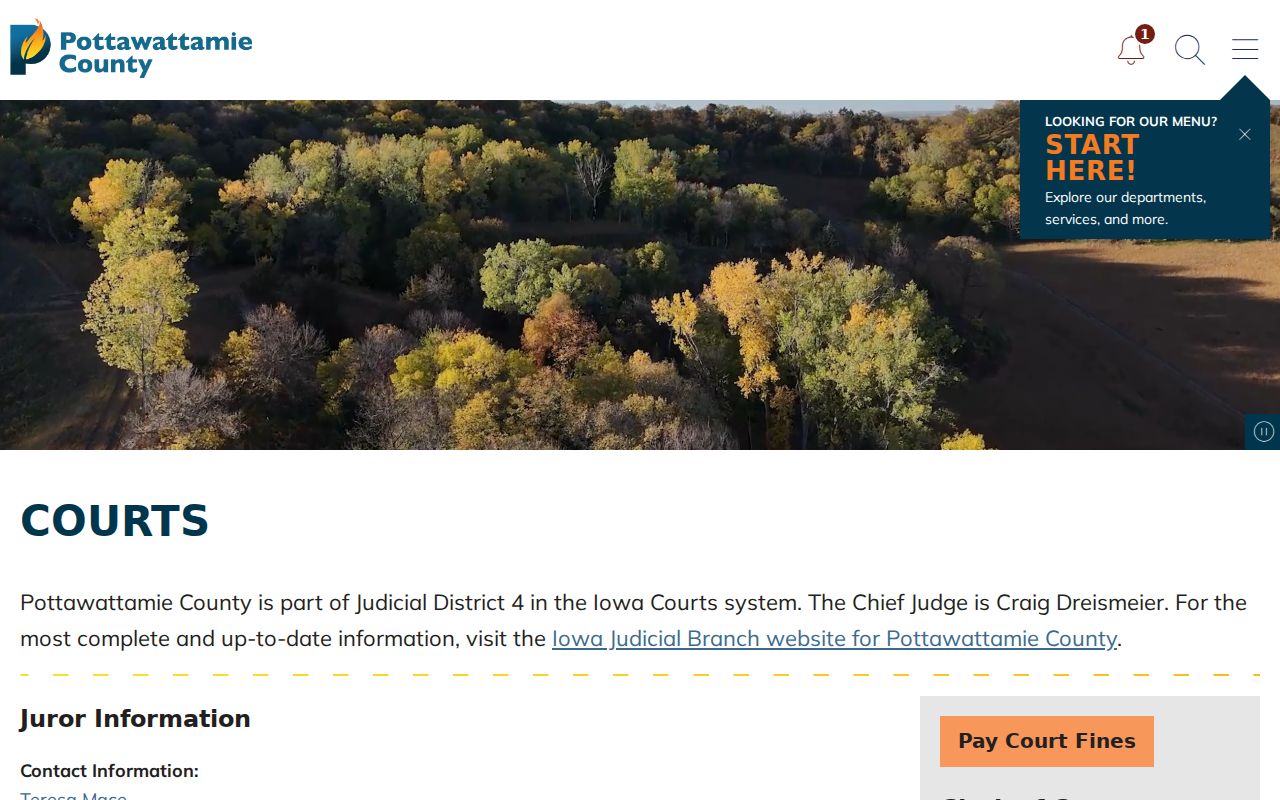
That official courthouse route matters when a remote docket link does not reveal the public document itself.
Pottawattamie Court Search Fields
Iowa Courts Online is the statewide portal for Pottawattamie County criminal case searches. Its official field guide says the name route accepts at least two letters in the Last/Firm Name field. A percent sign acts as a wildcard, and a first initial is entered without a period. The AND option looks for both entered names in one case; OR looks for either. Selecting Pottawattamie in the county control removes unrelated counties from the result set.
The official search interface shows why a careful set of fields works better than a broad name query.
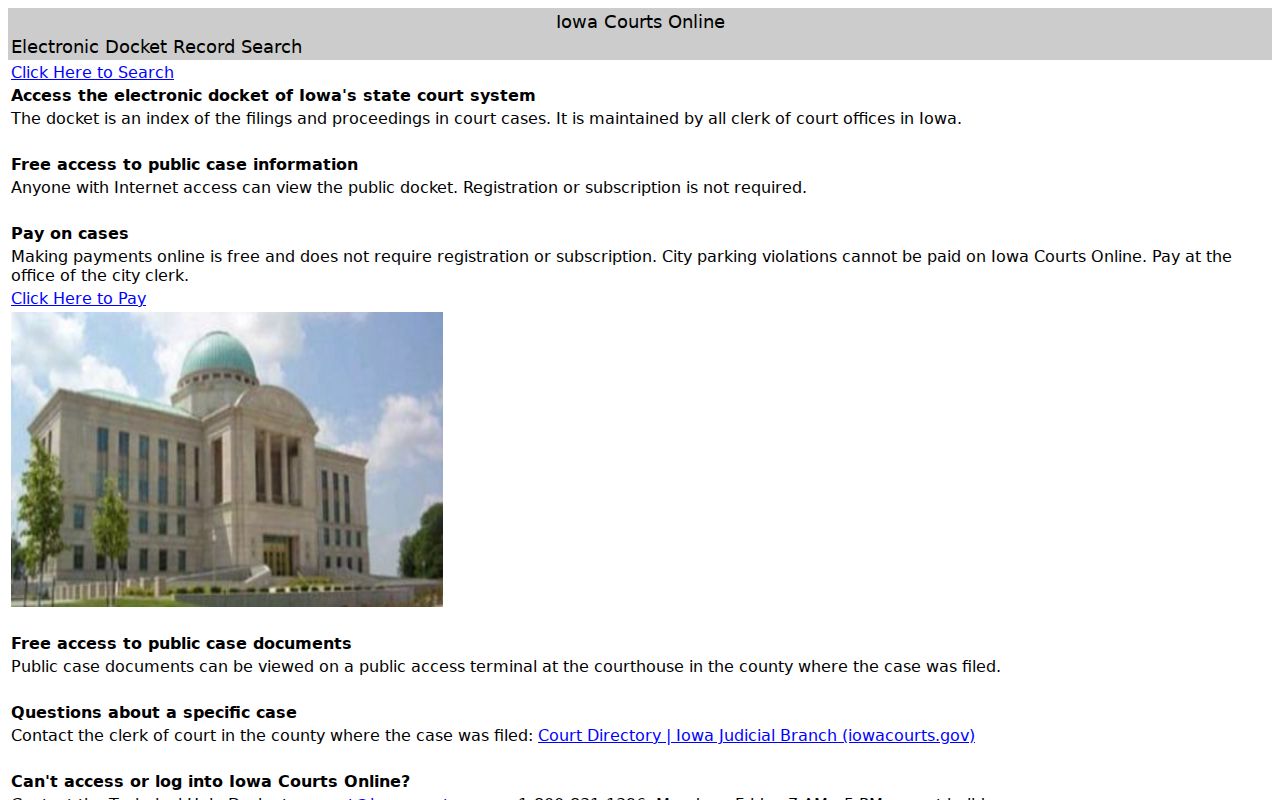
A known Case ID is the cleanest route, while case type and name variants can resolve a crowded result list.
| Field Label | Type | Required | Notes |
|---|---|---|---|
| Search type | Tab or menu | Yes | Choose Trial Court Case Search or Name Search |
| Last/Firm Name | Text | Yes for name search | Enter two or more letters; % is a wildcard |
| First and Middle Name | Text | No | Use an initial without a period; middle name can narrow matches |
| AND/OR | Radio | Conditional | AND requires both names; OR allows either name |
| County | Dropdown | No | Select Pottawattamie for local criminal cases |
| Case ID or Number | Text | Route dependent | Use the direct route when the identifier is known |
| Case Type | Dropdown | No | Limit results to offered criminal or traffic categories |
Searching Pottawattamie County Case Records
Begin with the facts that identify the court matter, not just a person’s name. A case number, filing year, and exact indexed spelling reduce false matches. Then read through the last meaningful docket event. An arrest charge can change when the County Attorney files a trial information, and one case may contain several counts with different outcomes.
- Open Iowa Courts Online and choose the trial court name-search or case-number route.
- Enter the indexed surname or Case ID, then select Pottawattamie County and the relevant case type.
- Open the Case ID and compare the title, filing date, party role, and charge sequence.
- Follow docket events through plea, dismissal, judgment, or sentence. Check each count separately.
- Call the Clerk of District Court for public documents, certified copies, older files, or links that are unavailable remotely.
A basic public case search is free. Advanced searching and remote document access may require a paid subscription. Ask the clerk for current copy, certification, and search costs before ordering because the research did not establish a current local fee schedule.
Pottawattamie Court Terminal Access
A bracketed or unavailable document link does not always mean the filing is sealed. EDMS security levels control which cases and documents can be viewed by each user class, and remote access can be narrower than courthouse access. Public terminals on the courthouse’s fourth floor permit viewing of public online documents that may not open for a free remote user.
For an older Pottawattamie County criminal case, give the clerk the full name, approximate year, and case number if known. The clerk can explain how to request a public copy or certified record. Court staff can provide process and forms, but not legal advice. Open search-warrant material, confidential cases, juvenile files, protected addresses, and victim or minor data can remain outside public view.
The courthouse route is also useful when two similar names appear online. Compare the case title, filing year, charge sequence, and public hearing details at the terminal. If those facts still do not resolve the match, ask the clerk which public identifier can be used without seeking protected personal data. This keeps the inquiry tied to the Pottawattamie court file rather than an assumption based on a name.
Note: A missing remote document may reflect user-access limits, while a missing public case may reflect confidentiality or different indexing.
Inside a Pottawattamie County Case File
A Pottawattamie criminal case file records the court action after a charge is filed. It can identify the prosecuting party, attorneys, charge amendments, hearings, rulings, and the outcome of each count. The financial ledger may also show fines, surcharges, costs, payments, and balances. It does not establish a complete statewide arrest history or prove that a name match belongs to one person.
| Case ID and Court | County, case title, filing date, type, subtype, status, and status date |
|---|---|
| Charging Record | Charge sequence, description, Iowa Code reference, offense class, amendments, and disposition |
| Parties and Counsel | Party names and roles, attorneys, and the State of Iowa as prosecuting party |
| Docket Events | Filings, appearances, arraignment, motions, hearings, pleas, orders, and warrant-related public events |
| Disposition and Judgment | Conviction, dismissal, acquittal, deferred judgment, or another recorded end for each count |
| Sentence and Money | Sentence terms, court costs, fines, surcharges, payments, restitution where public, and balance |
Compare the filed charge with any earlier booking allegation. For the arrest and custody side of the same event, the county’s arrest lookup channels explain why the jail record and court file may differ.
Pottawattamie Criminal Case Codes
Iowa case numbers may use FECR for felony criminal, AGCR for aggravated misdemeanor criminal, and SMCR for simple misdemeanor criminal. Those labels describe the file category. They do not state whether a person was convicted. The disposition field and the later docket entries answer that question.
- Trial information
- The prosecutor-filed charging instrument commonly used for an indictable Iowa offense.
- Arraignment
- The hearing where the formal charge is presented and a plea is entered.
- Disposition
- The outcome of a case or charge, such as conviction, dismissal, or acquittal.
- Deferred judgment
- A judgment held back while conditions are completed; successful discharge is a nonconviction but has distinct repository treatment.
- Docket
- The dated register of filings, hearings, orders, and other case events.
How a Criminal Case Moves
A Pottawattamie County criminal case may begin after an arrest or citation, but the prosecutor’s filed count controls the court case. The initial appearance addresses custody and release. A complaint, trial information, or less commonly an indictment states the charge. Arraignment follows, then discovery, motions, and pretrial work. The matter can end through a negotiated plea, trial, dismissal, or acquittal before any sentence or appeal.
Case flow: Charges Filed › Arraignment › Pretrial › Plea or Trial › Disposition › Sentencing
Read the entire event sequence. A dismissed count can sit next to a conviction on another count. A deferred judgment is also not an ordinary conviction or an instant erasure. Its discharge and later public access must be checked in both the court record and, for personal review, the Iowa DCI record.
Pottawattamie County Attorney Filings
The Pottawattamie County Attorney prosecutes state criminal cases and maintains its Criminal Division on the courthouse’s fifth floor. The office is at 227 South 6th Street, can be reached at 712-328-5649, and publishes weekday hours of 8:00 a.m. to 4:30 p.m., with a noon to 1:00 p.m. closure. It also handles fine collection, juvenile justice, mental-health commitments, and victim or witness services.
The official county attorney page provides building and office context for the Pottawattamie prosecution side of a case.
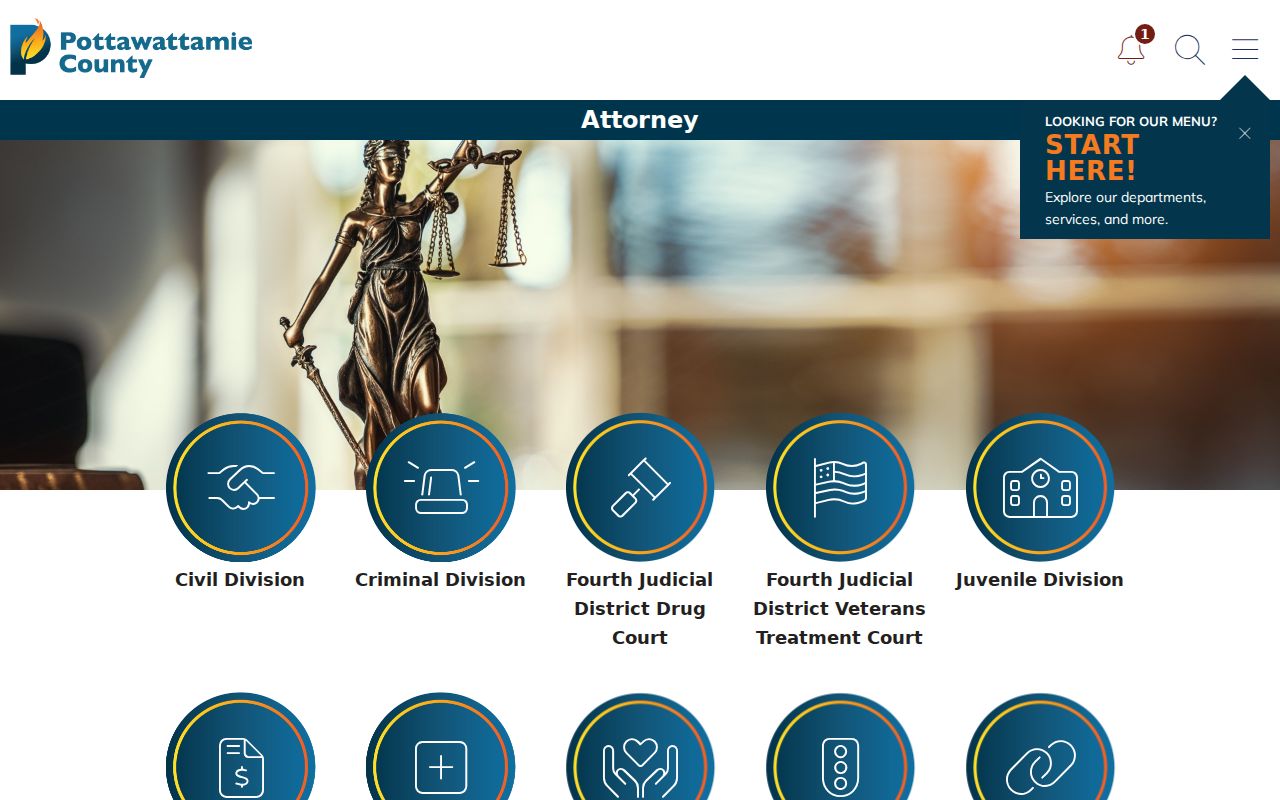
Prosecutors decide what charge to file, while the Clerk of District Court maintains the resulting public docket and court documents.
Pottawattamie Specialty Court Dockets
Judicial District 4 has a named Drug Court, Veterans Treatment Court, and Southwest Iowa Mental Health Court programs. Their dockets may contain treatment reviews, status hearings, supervision milestones, and program orders. Those events do not necessarily mark a new criminal charge. They can show a problem-solving court’s continued oversight of an existing Pottawattamie County case.
Eligibility and participation are decisions for the court and program team. They are not public opt-in services. When a docket has repeated review entries, first confirm the case number and charge sequence, then read the associated public orders. The distinction helps a reader avoid counting each review as a separate prosecution.
These entries may also continue after the main plea or judgment event. A chronological read makes the role of each review clear. Look for the event label, judicial officer, and any public order before drawing a conclusion about the current case status.
Case Record Access & Restrictions
Iowa Open Records Law supports access to public records, but it does not override specific confidentiality rules. Juvenile court records are generally confidential under Iowa Code section 232.147. EDMS rules can also restrict confidential cases, open search-warrant matters, protected addresses, personal identifiers, and victim or minor information.
When part of a Pottawattamie County criminal case is public and part is protected, ask the clerk what public docket entries or documents remain available. Court records should come from Iowa Courts Online or the Clerk of District Court, not from a broad sheriff request. A court disposition may later qualify for expungement under Iowa Code chapter 901C, but dismissal alone does not mean that every arrest or repository record has vanished.